Long-throw ALR guide
Continue to the next decision in the screen-selection process.
The most expensive screen mistake is buying an ALR surface designed for the wrong projector geometry.
| Projector type | Typical placement | Screen concern |
|---|---|---|
| Standard / long throw | Several feet/meters from screen, often ceiling mounted | Use ALR material engineered for conventional front projection |
| Short throw | Closer to screen | Check exact screen compatibility; geometry sits between categories |
| UST | Very close, normally below screen | Use UST-specific ALR/CLR material that handles steep upward light |
A UST projector throws light upward at a steep angle from a console very close to the wall. Its screen structure is designed around that geometry. A standard projector sends light from much farther away and closer to perpendicular. Mixing those systems can cause severe brightness and uniformity problems.
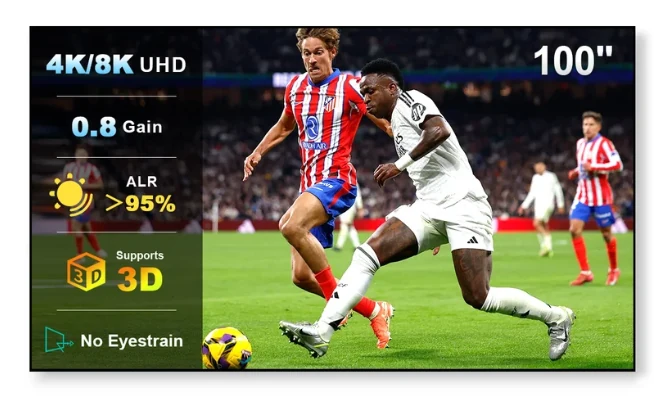
It means the material's optical behavior is intended for conventional projector placement. The featured NothingProjector screen is specifically labeled for standard and long-throw projectors and should not be treated as a UST screen merely because both products use the ALR label.
“Short throw” covers a range of throw ratios and installation geometries. Do not assume a long-throw or UST-specific ALR screen will be ideal. Check the screen maker's compatibility information for your exact projector setup.
The featured NothingProjector product is made for that category and is offered in large fixed-frame sizes.
Check Current Price & Availability