ALR vs white vs gray
Continue to the next decision in the screen-selection process.
A long-throw ALR screen is designed to send useful projector light toward the audience while reducing the impact of stray light arriving from other directions.
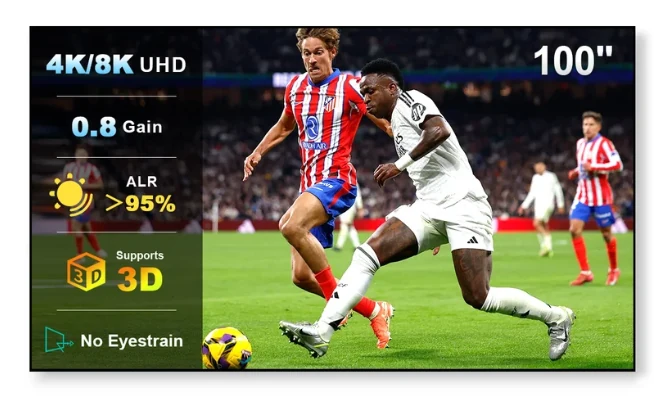
Ambient light rejecting does not mean a screen magically blocks all room light. It means the surface is engineered to favor light arriving from the projector's expected direction and reduce light coming from less useful angles. The design can improve perceived contrast when lamps, windows or bright walls would otherwise wash out the image.
This is the most important compatibility point in the category. A UST projector sends light upward from very close to the screen. A conventional standard/long-throw projector sends light from much farther away. Screen structures that are optimized for one geometry can behave badly with the other.
A bright standard projector in a living room where you can reduce, but not eliminate, ambient light.
A dim projector, direct sun hitting the screen and a huge image size that spreads limited light too thin.
The featured NothingProjector screen is explicitly sold for standard/long-throw projectors. Its published specifications include 0.8 gain, 170° viewing angle and 100/120/130-inch size choices. NothingProjector also recommends 2,000 ANSI lumens or more. Those numbers make it a sensible product to investigate when room light is the problem but a conventional projector remains the source.
Even a strong ALR surface benefits from blinds, controlled lamp placement and darker surfaces near the screen. The practical goal is not “daylight immunity.” It is to improve the signal-to-stray-light relationship so the projected image holds more contrast in normal living conditions.
Check the current NothingProjector listing for size, shipping, price and final compatibility details.
Check Current Price & AvailabilityUsually that is the wrong match. Directional UST/CLR material is designed around a very different light angle.
Do not plan around that. Direct sunlight is far more challenging than normal indoor ambient light.
No. Gain is a tradeoff involving brightness distribution, viewing angle and screen behavior; it is not a simple quality ranking.