Long Throw ALR Guide
How the category works and where it fits.
Read guide →Ambient-light rejection is an optical system. These guides connect screen material to projector throw, gain, room light and mounting geometry.
How the category works and where it fits.
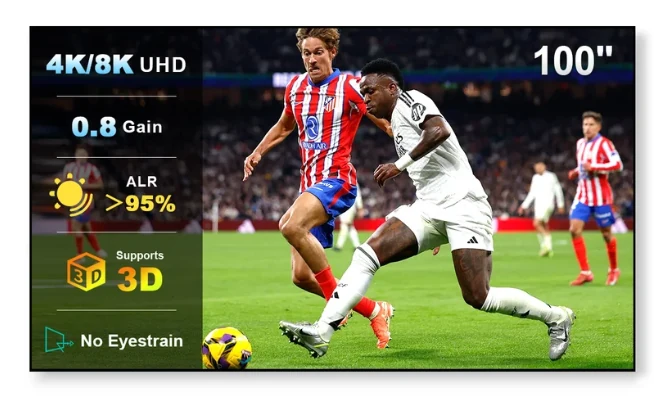
Read guide →Why 0.8 vs 1.0 is a tradeoff, not a score.
Read guide →Choose by the room and projector.
Read guide →Do not mix incompatible ALR geometries.
Read guide →Directional material and installation geometry.
Read guide →Control the room before chasing specs.
Read guide →Start with projector geometry, then room light, then screen gain and mounting. That order prevents the common mistake of choosing an ALR material by marketing percentage before confirming whether its optical structure matches the projector.
Standard/long-throw, short-throw and UST projectors send light to the screen from different angles. Directional ALR surfaces are built around those angles.
Window direction, ceiling fixtures and bright surfaces matter. ALR is most useful when stray light can be reduced but not completely removed.
A lower-gain screen can still look better in a lit room if it protects contrast, but the projector must have enough output for the chosen diagonal.