Choose 100, 120 or 130 inches
Continue to the next decision in the screen-selection process.
The strongest case for this screen is simple: you use a standard or long-throw projector, you cannot make the room fully dark every time, and you want a fixed screen that is designed to preserve perceived contrast under ambient light.
We have not physically tested this screen. This review separates manufacturer-published specifications from independent comparison findings.
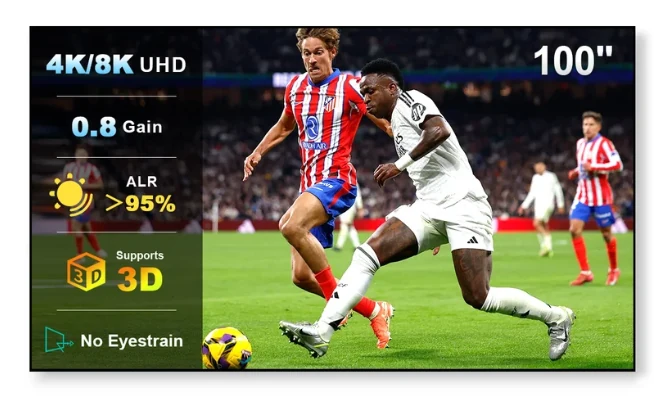
NothingProjector sells this as a lenticular 4K ALR screen for standard and long-throw projectors. The current product listing shows 100, 120 and 130 inch sizes, a 0.8 gain, a 170-degree viewing angle and a manufacturer claim of 95% ambient light rejection. The company also lists support for 3D, 4K and 8K content and recommends a projector with at least 2,000 ANSI lumens.
| Published specification | NothingProjector Long Throw ALR Screen |
|---|---|
| Projector compatibility | Standard / long-throw projectors |
| Available sizes | 100", 120" and 130" |
| Gain | 0.8 |
| Viewing angle | 170° |
| Ambient light rejection | 95% manufacturer claim |
| Resolution support | 3D / 4K / 8K listed by manufacturer |
| Surface | Enhanced long-throw ALR material; tensioned fixed-frame design |
| Brightness guidance | Manufacturer recommends 2,000 ANSI lumens or more |
This product is most compelling in a multi-purpose room where you want a large image without blacking out every window or turning off every lamp. A lower-gain ALR surface can trade some raw reflected brightness for better control of stray light. That trade can be useful when the projector already has adequate light output and the room is the bigger problem.
A 2026 comparative test by The Hook Up evaluated ten standard-throw screen materials. In that test, the NothingProjector lenticular long-throw material performed very similarly to some substantially more expensive lenticular-fusion ALR materials. The test also highlighted an important category-level tradeoff: ALR designs differ in hotspotting, laser speckle, gain and how they behave with projector mounting geometry. That is why the screen material should be chosen as part of the optical system, not by headline ALR percentage alone.
The screen is explicitly positioned for standard and long-throw projectors. That matters because UST ALR screens use different directional structures.
A published 170° viewing angle is attractive for wider seating layouts where multiple people watch from different positions.
100, 120 and 130 inches cover common home-cinema and big-room targets without creating a huge SKU maze.
The core reason to buy is not resolution labeling; it is the directional screen surface designed to reduce the visual damage from stray room light.
Shortlist it if your projector is standard/long throw, your room has meaningful ambient light, your projector has enough brightness for the chosen image size, and you want a fixed-frame screen in the 100–130 inch range. If you have a UST projector, a dark dedicated theater with excellent light control, or a room that requires a retractable screen, another screen type may fit better.
NothingProjector's lenticular long-throw ALR screen sits in a useful niche: a large, fixed ALR surface for conventional projector placement. Its published 0.8 gain and 170° viewing angle point to a balanced design rather than a high-gain, narrow-cone approach. The decisive questions are your projector brightness, throw type, mounting geometry and room light.
Check Current Price, Sizes & AvailabilityNo. The product is marketed for standard and long-throw projectors. UST projectors normally need a different ALR/CLR screen structure.
Not necessarily. Lower gain can be part of an ALR design that prioritizes contrast and ambient-light control, but your projector still needs enough light for the chosen image size.
No. That is a manufacturer-published claim, not a guarantee of performance in every room. Window direction, direct sunlight, projector brightness and screen size all matter.
Measure the wall and seating distance first, then use our 100 vs 120 vs 130 inch size guide before ordering.